Furniture removal in Massachusetts: What homeowners need to know
- Joe Lusso
- May 14
- 10 min read


TL;DR:
In Massachusetts, illegal curbside furniture disposal can lead to costly fines and environmental violations. Proper removal requires scheduling with municipal services, donating, or hiring licensed professionals to ensure compliance and eco-friendly practices. Working with knowledgeable vendors ensures legal, efficient, and sustainable furniture disposal tailored to local regulations.
Dragging an old sofa to the sidewalk and expecting it to vanish by morning sounds reasonable enough, but in Massachusetts, that assumption can cost you real money. Most towns across the state prohibit leaving large items at the curb without a scheduled pickup, and violations can result in fines that dwarf the cost of hiring a removal service in the first place. Beyond the legal risk, improper furniture disposal contributes to landfill overcrowding and missed recycling opportunities that affect every community. This guide walks you through exactly what furniture removal means, how Massachusetts rules shape your options, and how to handle the whole process efficiently and legally.
Table of Contents
Key Takeaways
Point | Details |
Check local rules | Massachusetts requires specific bulk-item scheduling, so never assume you can leave furniture at the curb. |
Recycle mattresses | State law bans most mattresses from landfills, making specialized recycling mandatory. |
Professional help saves time | Hiring a removal service reduces legal risks, improves recycling rates, and makes the job hassle-free. |
Separate for recycling | Sorting items for donation, recycling, or disposal is both required and environmentally responsible. |
Understanding furniture removal: Definition and options
Furniture removal is not the same as putting your weekly trash out. It refers to the planned, safe clearing of large or bulky items from your property, including sofas, bed frames, dressers, dining tables, mattresses, and office chairs. These items are too large for standard curbside bins and almost always need separate handling. Many homeowners learn this the hard way when their municipality leaves the furniture right where they put it, sometimes with a warning notice attached.
The good news is that Massachusetts residents have several legitimate options for clearing unwanted furniture. The right choice depends on your timeline, budget, and the condition of the items.
Your main furniture removal options:
Municipal bulk pickup. Most cities and towns offer scheduled bulk item collection, but you typically need to call ahead or book online. Bulk item disposal rules vary significantly from one municipality to the next, so confirm the specific requirements for your address before dragging anything outside.
Donation. Gently used furniture in good condition can go to local thrift stores, nonprofit organizations, or community groups. Many will even pick up for free, which makes this a zero-cost option when it works.
Recycling programs. Some materials in furniture, particularly metal frames, wood, and foam, can be separated and recycled. Mattresses require their own certified recycling pathway under state law.
Professional junk removal. A licensed removal company handles everything from loading to proper sorting and disposal. This is the fastest and often the most legally reliable option, especially for large volumes or items with special disposal requirements. Check which items qualify as bulk furniture before your pickup to avoid surprises.
Method | Cost | Speed | Eco-friendly | Compliance risk |
DIY curbside drop-off | Free | Fast (but risky) | Low | High |
Municipal bulk pickup | Free to low | Slow (scheduling needed) | Medium | Low if scheduled correctly |
Donation | Free | Medium | High | Low |
Professional removal | Moderate | Fast to same-day | High | Very low |
The table makes one thing clear: DIY curbside is the highest-risk option despite feeling like the easiest. Professional removal sits at the opposite end, offering speed and near-zero compliance risk when you use a reputable, insured provider.
Legal rules and eco-friendly disposal: Massachusetts requirements
Massachusetts takes bulk waste seriously. The state’s sanitary code places responsibility squarely on property occupants and owners to dispose of bulk items in line with municipal requirements, which means “I didn’t know” is not a workable defense. Towns like Boston, Worcester, Springfield, and dozens of smaller communities all have their own rules about when and how to schedule large item collection. Some require 48 hours’ notice, others require a full week, and some charge a nominal fee per item.
Mattresses are in a category of their own. Following a statewide mattress disposal ban, Massachusetts now prohibits sending mattresses to landfills or incinerators. They must travel to state-approved recycling facilities. Leaving a mattress at the curb is not just an ordinance violation. It is a direct violation of state environmental law. This is a detail that catches a surprising number of homeowners and property managers off guard every year.
Statistic callout: Studies of Massachusetts municipal waste programs consistently show that a large majority of towns, often cited at over 80 percent, require advance scheduling for bulk item pickup rather than allowing spontaneous curbside placement.
How to legally dispose of furniture in Massachusetts:
Identify the item category. Is it a regular furniture piece, a mattress, or something with electronic components? The category determines the disposal route.
Check your municipality’s rules. Go to your city or town’s official website and look for the public works or sanitation department. Confirm scheduling windows, fees, and set-out guidelines.
Schedule the pickup or find an alternative. If municipal pickup has a long wait time, compare donation pickup availability or get a quote from a licensed removal service.
Prepare the items. Remove loose cushions, disassemble large frames if required, and keep the items accessible on the scheduled date.
Confirm mattress-specific handling. For mattresses, confirm that whoever picks them up routes them to a certified recycling facility, not a general waste stream.
Get documentation if needed. Property managers and landlords dealing with tenant move-outs should keep records of proper disposal to protect themselves legally.
Pro Tip: Always ask your removal vendor in writing whether they are compliant with Massachusetts mattress recycling requirements and local bulk-item ordinances. A legitimate company will answer this without hesitation, and that answer protects you.
Exploring your full range of MA furniture disposal options can also reveal less obvious routes, like furniture-specific recycling events that some towns host seasonally. For a greener angle, decluttering sustainably covers how to maximize the amount of material that stays out of landfills, and a broader guide to sustainable disposal covers the full picture for Massachusetts households.

The process: How furniture removal works in Massachusetts
Knowing the rules matters, but understanding the actual workflow from start to finish takes the mystery out of the whole thing. Here is what a typical professional furniture removal job looks like in Massachusetts.
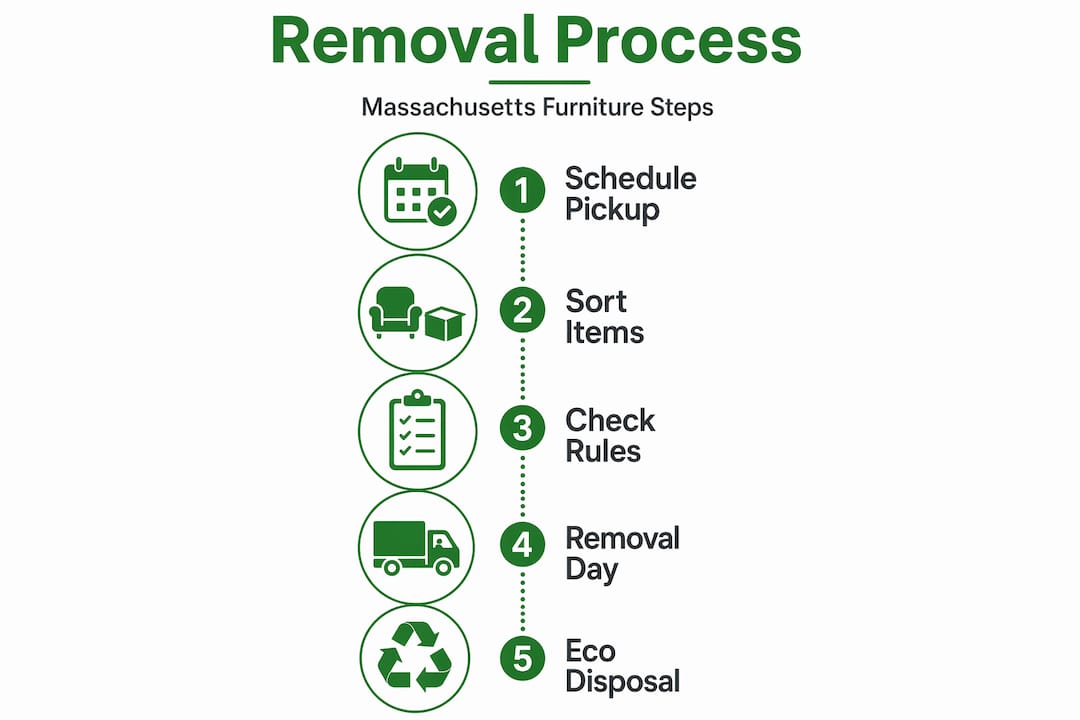
Step-by-step removal process:
Initial inquiry and booking. Most professional services offer online booking, phone quotes, or both. You describe the items, confirm your location, and get a price estimate. Same-day or next-day availability is common with local providers.
Pre-removal preparation. You clear pathways, move smaller items out of the way, and confirm access to the space. You do not need to carry anything heavy yourself.
Crew arrival and assessment. An insured crew arrives within the scheduled window, assesses the items, and confirms the scope of work. They will flag any items needing special handling, like mattresses.
Loading and sorting. This is where a good removal company separates items into three streams: donation, recycling, and disposal. Furniture in reusable condition goes to local thrift organizations. Metal, wood, and foam go to appropriate recyclers. Only what cannot be diverted goes to a transfer station or landfill.
Final walkthrough. The crew confirms the area is cleared and leaves the space clean.
Disposal confirmation. Reputable services provide documentation or verbal confirmation of where items went, which matters for property managers tracking legal compliance.
The difference between homeowner and property manager responsibilities deserves attention. Homeowners are generally managing their own belongings and timelines. Property managers are dealing with tenant move-outs, common area cleanouts, and legal accountability that makes mistakes more costly. Research from Boston’s coordinated furniture pick pilot found that managing curbside bulk set-out across multiple units creates real operational risk and delays, while professional removal reduces sorting errors and keeps more material out of the landfill.
For a more detailed breakdown of responsibilities and logistics specific to rental properties, the property manager junk disposal tips guide is worth bookmarking.
Pro Tip: Ask your removal vendor for a written summary of their disposal plan before they arrive. A good vendor will have no hesitation explaining exactly where your items go, and that transparency is your best protection against unknowingly contributing to illegal dumping.
Cost, benefits, and pitfalls: What most people miss
Most people underestimate what furniture removal actually costs when they try to handle it themselves, and overestimate it when considering professional services. The real calculus involves more than a price quote.
What drives the cost of professional furniture removal:
Item size and weight. A sectional sofa takes significantly more labor and truck space than a single chair.
Volume. Removing one piece versus clearing an entire apartment are priced differently.
Urgency. Same-day or weekend removal typically costs a bit more than booking a few days out.
Special disposal requirements. Mattresses, items with foam, and anything requiring certified recycling may add a small fee to cover compliant processing.
Distance to disposal or donation centers. Providers operating closer to certified facilities may pass along lower costs.
Tips for managing cost and maximizing value:
Book at least two to three days ahead when possible to access standard pricing.
Donate items in advance to reduce the total volume a removal company needs to take.
Bundle multiple pieces into one job rather than scheduling multiple pickups.
Ask whether your vendor donates usable furniture, since that sometimes reduces the overall disposal cost.
Confirm mattress handling upfront to avoid surprise fees.
“Improperly placing furniture at the curb can create legal risk for residents and property owners. The time and money spent dealing with a fine or a re-removal job far exceeds the cost of booking a compliant service in the first place.”
The hidden benefits of professional removal are significant. Beyond legal protection, you recover your time, support local donation networks, and keep more material out of landfills. A homeowner who tries to manage a multi-item clearout alone may spend an entire weekend hauling, scheduling, and driving, while a professional team handles the same job in two hours. The value of recycling bulky items extends beyond personal convenience as well: it reduces the burden on municipal waste infrastructure and supports local circular economy initiatives.
Common pitfalls to avoid:
Leaving furniture at the curb without a scheduled appointment
Forgetting that mattresses require a separate, certified recycling route
Mixing recyclable items with general waste during a DIY cleanout
Failing to book a removal vendor who is insured and familiar with local regulations
Assuming property managers are exempt from the same rules as individual homeowners
For more on making your disposal choices as planet-friendly as possible, eco-conscious disposal advice covers both residential and commercial scenarios across Massachusetts.
Our take: What Massachusetts residents should really know about furniture removal
Here is something most guides will not tell you: furniture removal in Massachusetts is genuinely harder to self-manage than it looks, and the gap between “easy” and “legal” is wider than most people expect.
We see it regularly. A homeowner stages a couch at the curb on a Monday, assuming it will be gone by Tuesday. Three days later, it is still there, and they are fielding a notice from the town. Or a property manager clears out a vacated unit, hauls everything to the dumpster, and later discovers that the mattress violated state recycling law. These are not edge cases. They are routine outcomes of treating furniture disposal like regular trash day.
The post-2022 mattress ban changed the landscape dramatically. Before that, many residents disposed of mattresses through informal channels that, while not technically proper, flew under the radar. Now there is real enforcement exposure. Any removal company, or individual, routing a mattress to a general landfill or incinerator is in violation. That shift makes it more important than ever to choose a removal partner who knows the current rules, not just the rules from three years ago.
There is also a practical efficiency case for combining donation, recycling, and professional removal in a single job. When a vendor separates your furniture correctly, items that still have life in them reach people who need them. That is a concrete community benefit, and it reduces what ends up in a transfer station. The furniture disposal options available today make it feasible to divert a significant percentage of a typical household clearout from landfill, but only if you work with someone who actively pursues that outcome rather than defaulting to the easiest disposal route.
The honest takeaway: the curb is not the answer in Massachusetts, and it probably was not the answer before, either. Working with a knowledgeable local service is not a luxury. For anyone managing a property or clearing out more than a single item, it is the most practical and legally sound path forward.
Ready for stress-free furniture removal in Massachusetts?
Navigating Massachusetts disposal rules on your own takes time, research, and real risk of getting something wrong. Junk Dispatch simplifies the whole process for homeowners and property managers across the state with insured crews, same-day availability, and disposal practices that comply fully with local and state requirements.

Whether you need a single couch hauled away or a full apartment cleanout, we sort items for donation and recycling before anything goes to disposal. Our team stays current on mattress recycling rules, bulk item ordinances, and eco-friendly disposal standards so you do not have to. We serve communities throughout the region, including Reading junk removal services and the broader Essex County area, and we handle large item and demolition removal as well. Get a free estimate online and book at a time that works for you.
Frequently asked questions
Can I put furniture on the curb in Massachusetts?
No. Most Massachusetts towns require a scheduled bulk pickup appointment and may issue fines for furniture placed at the curb without one.
What happens if I leave a mattress at the curb?
It violates state law. Since 2022, mattresses must be recycled through authorized programs and cannot be sent to landfills or left for general waste collection.
How do I get rid of a large couch in Massachusetts?
Schedule a bulk pickup with your municipality or hire a licensed removal service. The Massachusetts Sanitary Code places disposal responsibility on the property occupant or owner, so using an approved route protects you legally.
Is furniture removal different from junk removal?
Yes. Furniture removal focuses specifically on large, bulky items and typically involves more detailed sorting for donation, recycling, and compliant disposal compared to general junk removal.
Who pays for furniture removal in Massachusetts rentals?
Responsibility depends on the lease terms. Generally, property managers cover removal from common areas, while tenants are responsible for furniture left behind at move-out.
Recommended
Comments