Eco-Conscious Junk Disposal: What MA Homes Must Know
- Joe Lusso
- Apr 20
- 8 min read

TL;DR:
Massachusetts waste bans prohibit items like electronics, mattresses, and yard waste to protect the environment.
Proper disposal reduces landfill space, greenhouse gases, and community health risks.
Using licensed haulers and pre-sorting materials ensures compliance and environmentally responsible junk removal.
Most Massachusetts residents assume that hauling old furniture to the curb is perfectly fine. It isn’t. The state’s waste bans, which have been expanding since 1990, prohibit a long list of common household items from entering landfills or regular trash streams. Ignoring these rules isn’t just a legal risk. It contributes to methane emissions, strains local infrastructure, and puts your community’s health on the line. Massachusetts waste bans are designed to keep valuable and hazardous materials out of landfills, and understanding why those bans exist is the first step toward making smarter disposal decisions.
Table of Contents
Key Takeaways
Point | Details |
Waste bans matter | Massachusetts bans key materials from landfills to protect health, support recycling, and extend landfill life. |
Climate risk reduction | Eco-conscious junk removal reduces methane emissions from landfilled organics, helping combat climate change. |
Special handling required | Items like electronics and mattresses have strict disposal rules in Massachusetts—following them keeps you compliant and safe. |
Actionable solutions exist | Sorting junk, using reputable haulers, and choosing eco-friendly services all make decluttering better for your home, business, and the planet. |
How Massachusetts waste bans shape junk disposal
With the context set, let’s dig into what makes Massachusetts’ junk disposal rules unique.
Massachusetts started getting serious about landfill diversion back in 1990. Since then, the state has steadily added items to the restricted list. The idea is straightforward: some materials are too valuable to bury, and others are too dangerous. By banning them from the trash, the state forces both individuals and businesses to find better pathways for disposal.
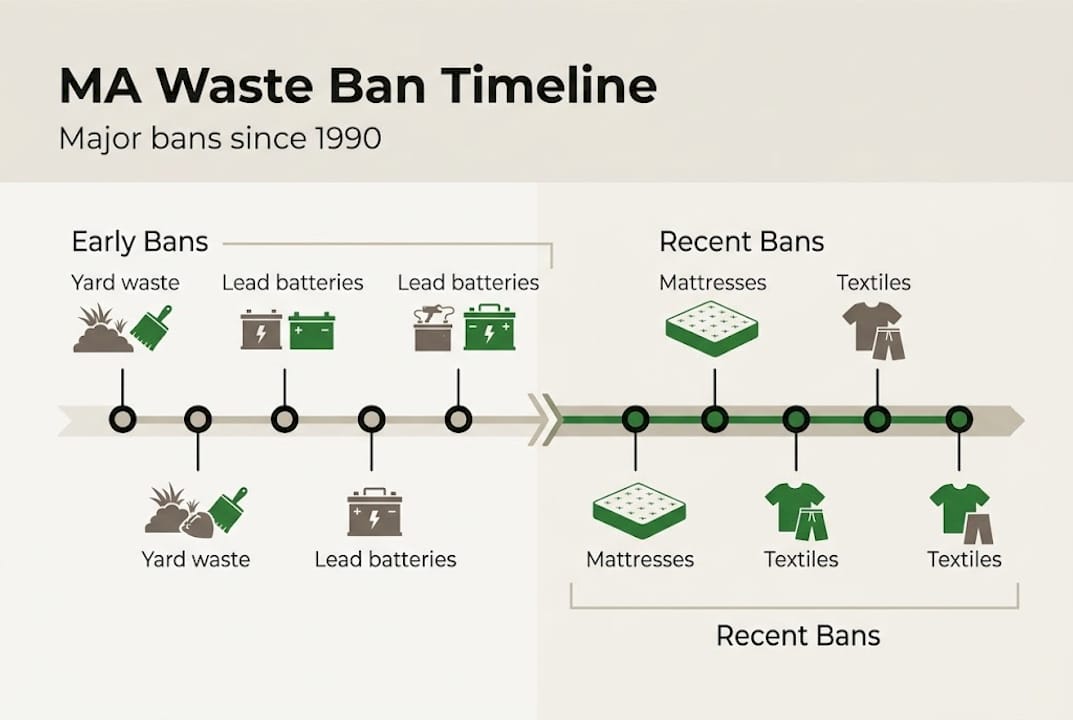
The banned items list has expanded since 1990, covering mattresses, textiles, and electronics, along with lead-acid batteries, white goods (large appliances), yard waste, and food waste above certain thresholds. Each of these categories carries its own logic. Mattresses clog landfill space and contain recyclable steel, foam, and fabric. Electronics hold toxic metals like mercury and lead. Textiles can be resold or repurposed. None of these belong underground.
Item Category | Ban Year (Approx.) | Primary Reason |
Yard waste | 1991 | Compostable, landfill space |
White goods/appliances | 1990 | Recyclable metals, refrigerants |
Lead-acid batteries | 1990 | Hazardous materials |
Electronics | 2000 | Toxic metals, recyclable parts |
Mattresses | 2022 | Recyclable materials, bulk space |
Textiles | 2022 | Reuse/recycling potential |
Food waste (large gen.) | 2014 | Organics diversion |
For homeowners in Massachusetts, this means a garage cleanout or property renovation can quickly get complicated. If your pile contains a busted TV, a stained mattress, or bags of old clothes, you can’t just call any hauler and expect the job to be done responsibly. Tracking junk disposal trends in 2026 shows that residents are increasingly searching for services that know the rules and follow them.
Key benefits of waste bans in Massachusetts:
Extends the life of existing landfills across the state
Protects groundwater from hazardous leachate
Supports local recycling and composting industries
Reduces greenhouse gas emissions from organic decomposition
Creates downstream markets for recoverable materials
Pro Tip: Before any cleanout, check your local transfer station’s accepted materials list and cross-reference it with the state’s waste ban schedule. Knowing this in advance saves time and avoids rejected loads.
For businesses, junk removal compliance isn’t optional. Commercial generators face direct scrutiny from MassDEP (Massachusetts Department of Environmental Protection), and violations can result in costly enforcement actions.
Environmental impact: Landfills, emissions, and climate risk
Understanding the regulations is just the first step. Let’s look at what happens to junk that isn’t handled the right way.
A landfill isn’t a bottomless pit. It’s a carefully engineered structure with limited capacity and a defined lifespan. When banned materials enter the waste stream, they either take up valuable airspace or introduce hazardous chemicals into the surrounding environment through leachate, which is liquid that filters through decomposing waste and can contaminate groundwater.
Organic material causes a separate but equally serious problem: methane gas. As food scraps, yard trimmings, and similar organics break down without oxygen underground, they produce methane. Methane is a potent greenhouse gas, and food waste is responsible for 58% of landfill methane emissions nationwide. That number should grab your attention.
Methane from landfills is over 80 times more potent than carbon dioxide over a 20-year window, making organic waste diversion one of the highest-leverage climate actions available at the local level.
Waste Type | Landfill Impact | Climate Impact |
Food waste | Accelerates methane production | High methane emissions |
Electronics | Leaches toxic metals | Moderate, plus material loss |
Textiles | Long decomposition, bulk space | Synthetic fibers persist |
Yard waste | Produces methane and leachate | Significant GHG contribution |
For Massachusetts homeowners and small businesses, the ripple effects are local. Landfill expansion in densely populated regions is politically and practically difficult. If existing facilities fill up faster due to improper disposal, costs rise for everyone. Tipping fees (the charges paid per ton of waste delivered) can increase, and those costs ultimately show up in your municipal tax bill or waste hauling invoices.

Good junk removal sustainability practices directly reduce these pressures. When materials are sorted and routed to the right facilities, fewer tons enter landfills, fewer methane molecules reach the atmosphere, and your community retains capacity for waste that truly has nowhere else to go.
Looking at the disposal impact for homeowners in Massachusetts specifically, it’s clear that even single-household decisions compound across millions of residents. Small choices made at the curb or during a cleanout have real effects at scale.
Special categories: Electronics, mattresses, textiles, and more
Beyond basic household trash, some items are subject to even stricter rules. Let’s break down why and what’s required.
Not all banned items are created equal. Some carry health risks during handling. Others require specialized infrastructure to process. And some require documentation to prove they’ve been properly managed. Knowing the difference helps you avoid costly mistakes.
Electronics are among the most tightly regulated. Electronics disposal in MA requires licensed and regulated recycling pathways. This applies to televisions, computers, monitors, and similar devices. The state tracks collection volumes and associated costs, meaning there’s real accountability built into the system.
Item | Disposal Requirement | DIY Option? |
TV/computer monitors | Licensed e-recycler required | Drop-off programs available |
Mattresses | Certified recycling facility | Retailer take-back programs |
Textiles | Donation center or recycler | Curbside textile bins |
Appliances with refrigerants | EPA-certified technician | No, requires certification |
Lead-acid batteries | Auto parts stores, recyclers | Drop-off only |
Here’s a step-by-step approach to sorting these items before calling a hauler:
Separate electronics into their own pile and confirm your hauler is a licensed e-recycler.
Check whether your mattress is eligible for a retailer take-back program or local recycling event.
Sort textiles into donate-worthy and damaged. Damaged textiles still have recycling options.
Flag any appliances with refrigerants. These require an EPA-certified handler, not just anyone with a truck.
Bag or box lead-acid batteries separately and note the count for your hauler.
Pro Tip: Some Massachusetts municipalities hold periodic collection events for hazardous household materials, including electronics and batteries. Check your town’s website before scheduling a private hauler, since these events can save you money.
For homeowners tackling a whole-house cleanout, recycling bulky items requires planning. For businesses generating higher volumes, the requirements are stricter and the penalties for non-compliance are steeper. Looking at junk removal service examples in Massachusetts shows how professional crews handle these distinctions as a matter of routine.
Practical steps for eco-conscious junk disposal in Massachusetts
Knowing the rules and the risks is only helpful if you know what to do next. Here’s how you can make junk removal safer and smarter.
The good news is that eco-conscious disposal doesn’t require you to become a waste management expert. It requires a clear process and the right partners. Proper sorting and using approved haulers reduces compliance risk and environmental harm significantly.
Follow these steps to set yourself up for a clean, responsible junk removal:
Inventory what you have. Walk through the space before anything gets moved. Identify banned items, hazardous materials, and standard recyclables.
Sort before the crew arrives. Group items by category: donate, recycle, compost, and dispose. A pre-sorted load moves faster and costs less.
Verify your hauler’s credentials. Ask directly whether they comply with MassDEP rules and what they do with sorted materials after pickup.
Ask for documentation. Reputable companies can tell you where your items go. Some provide receipts or manifest sheets for regulated materials.
Schedule appropriately. Eco-friendly disposal sometimes takes longer. Don’t leave banned materials sitting at the curb.
For homeowners looking to declutter sustainably, the prep work pays off in both peace of mind and reduced disposal costs. Donatable items reduce the total volume your hauler charges for, and recyclable materials often come with lower tipping fees.
Small businesses have a specific edge here. Implementing a simple internal sorting protocol means your team isn’t scrambling before a scheduled pickup. It also protects you legally if MassDEP ever inquires about your waste practices.
For outdoor cleanups, yard waste removal follows its own rules. Grass clippings, leaves, and brush must be composted or processed, not landfilled.
Pro Tip: Keep a running checklist of your regular waste categories and their proper disposal routes. Reviewing essential junk removal tips each year ensures your process keeps up with any regulatory updates in Massachusetts.
Key things to look for when vetting a hauler:
MassDEP registration or licensing
Clear policy on banned item handling
Transparent pricing with no surprise fees
References or reviews from local homeowners or businesses
Willingness to explain their end-of-material routing
A closer look: The real difference eco-conscious disposal makes in Massachusetts
Compliance with waste bans is the floor, not the ceiling. What we’ve seen working in communities across Massachusetts is that when residents and businesses treat disposal as a responsibility rather than a chore, the outcomes are measurably better for everyone nearby.
Here’s an uncomfortable truth: most illegal dumping and landfill contamination isn’t caused by bad actors. It happens because people don’t know what to do with an awkward item, so they take the path of least resistance. That path has real costs that get absorbed by your community through cleanup expenses, higher municipal fees, and degraded green spaces.
Choosing eco-friendly removal solutions isn’t just about personal virtue. It signals to your neighbors, your hauler, and your municipality what standard you expect. When enough households and small businesses make that choice consistently, it actually shifts how local waste infrastructure gets funded and prioritized. The ripple effect is real, and it starts with one pickup.
Eco-friendly junk removal starts here
Ready to make the responsible choice? Here’s how to take action in your community.
At Junk Dispatch, we’ve built our entire operation around the disposal standards that Massachusetts requires and the environmental outcomes your community deserves. Every load we pick up is sorted, documented, and routed to the right facility, whether that’s a licensed e-recycler, a composting partner, or a donation center.
We serve homeowners and businesses across the state, including Reading junk removal and the wider Essex County area. Whether you need a full garage and attic cleanout or a one-time pickup of banned items you’re not sure how to handle, we make it easy to book, get a free estimate, and schedule same-day service. You handle the sorting. We handle everything else responsibly.
Frequently asked questions
What items are banned from Massachusetts trash and landfills?
Banned items include mattresses, textiles, electronics, lead-acid batteries, and large food waste, among others. The state’s banned list has grown steadily since 1990, covering a wide range of materials that can be recycled or composted instead.
How does eco-conscious junk disposal reduce climate impact?
Diverting organics and recyclables from landfills lowers methane emissions, protecting air quality and the climate. Food waste alone is responsible for 58% of landfill methane emissions released to the atmosphere, making diversion one of the most impactful actions available.
What risks do businesses face from improper junk disposal in Massachusetts?
Businesses risk regulatory fines and increased operational costs if they ignore waste diversion regulations. MassDEP’s commercial food waste ban requires large businesses to divert food waste and reports significant economic impacts for those who don’t comply.
Why do electronics require special disposal in Massachusetts?
Electronics contain hazardous materials and must be recycled through licensed facilities per state rules. The state actively tracks collection volumes and associated costs, ensuring accountability throughout the electronics recycling process.
Recommended
Comments