What is demolition service: a Massachusetts homeowner's guide
- Joe Lusso
- May 15
- 8 min read

TL;DR:
Demolition services involve coordinated engineering processes, permits, hazard surveys, and debris removal, especially in Massachusetts due to strict asbestos regulations. Proper planning, licensing, and compliance are essential to avoid delays, legal issues, and safety hazards, making expert guidance crucial. Junk Dispatch offers reliable debris removal services across Massachusetts to efficiently manage post-demolition cleanup and ensure project completion.
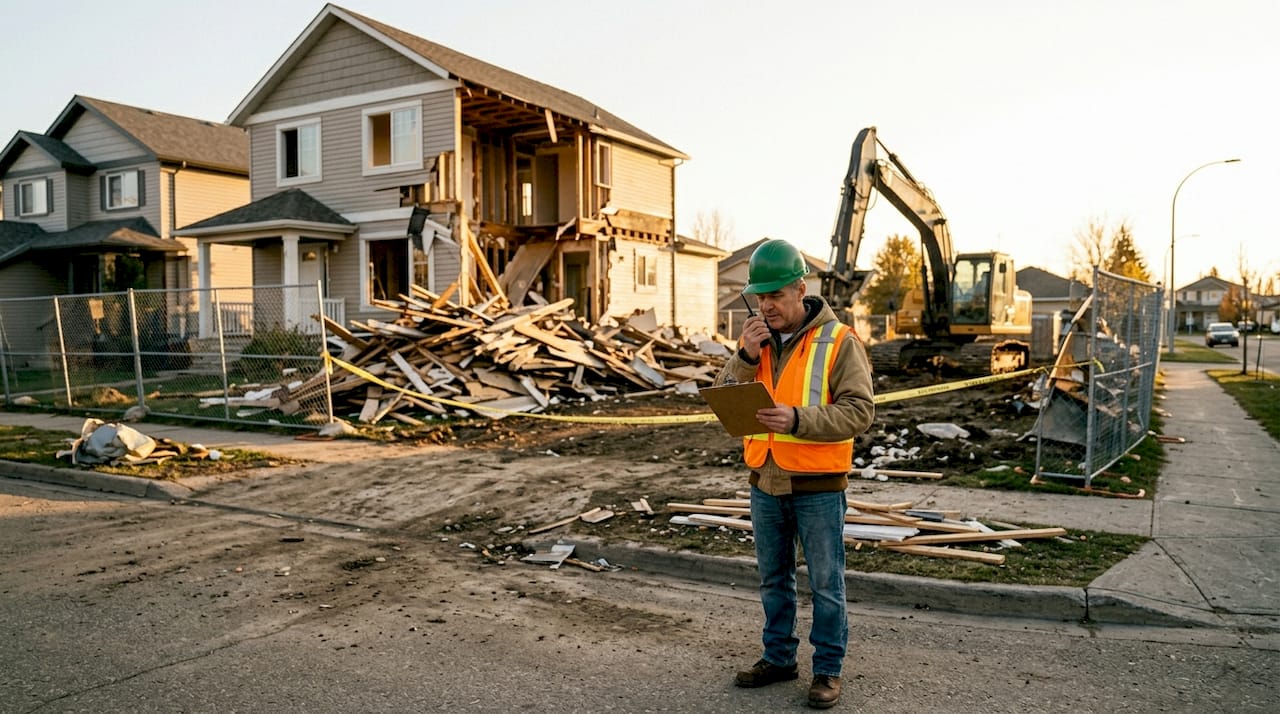
Most people picture a wrecking ball swinging into a crumbling wall and call it a day. But what is demolition service, really? It is a coordinated engineering process involving permits, hazard surveys, regulated waste disposal, and carefully sequenced physical work. In Massachusetts, the complexity runs even deeper because of strict asbestos and air-quality regulations that apply to nearly every demolition project, residential or commercial. Whether you are tearing down a garage, gutting a commercial space, or clearing a fire-damaged structure, understanding what demolition services actually involve will save you time, money, and serious legal headaches.
Table of Contents
Understanding demolition services: more than just tearing down buildings
Massachusetts demolition regulations: asbestos and safety requirements you must know
How demolition methods vary: choosing the right approach for your property
Practical step-by-step guide to hiring and working with demolition services in Massachusetts
Choose Junk Dispatch for reliable demolition debris removal in Massachusetts
Key Takeaways
Point | Details |
Demolition is more than tearing down | It involves engineering, safety planning, and hazardous materials management to protect people and property. |
Massachusetts asbestos rules apply | Removing asbestos before demolition is mandatory under state regulations to avoid fines and delays. |
Method matters for safety | Top-down demolition is often best for urban sites to control debris and maintain stability. |
Plan before you hire | Proper scheduling and permits prevent costly delays and unsafe work conditions on your property. |
Choose reliable debris removal | Combining demolition with professional junk removal streamlines cleanup and site preparation. |
Understanding demolition services: more than just tearing down buildings
Demolition is the science and engineering of safely and efficiently taking down structures, contrasting with deconstruction, which carefully preserves valuable materials for reuse. That distinction matters more than most property owners realize.
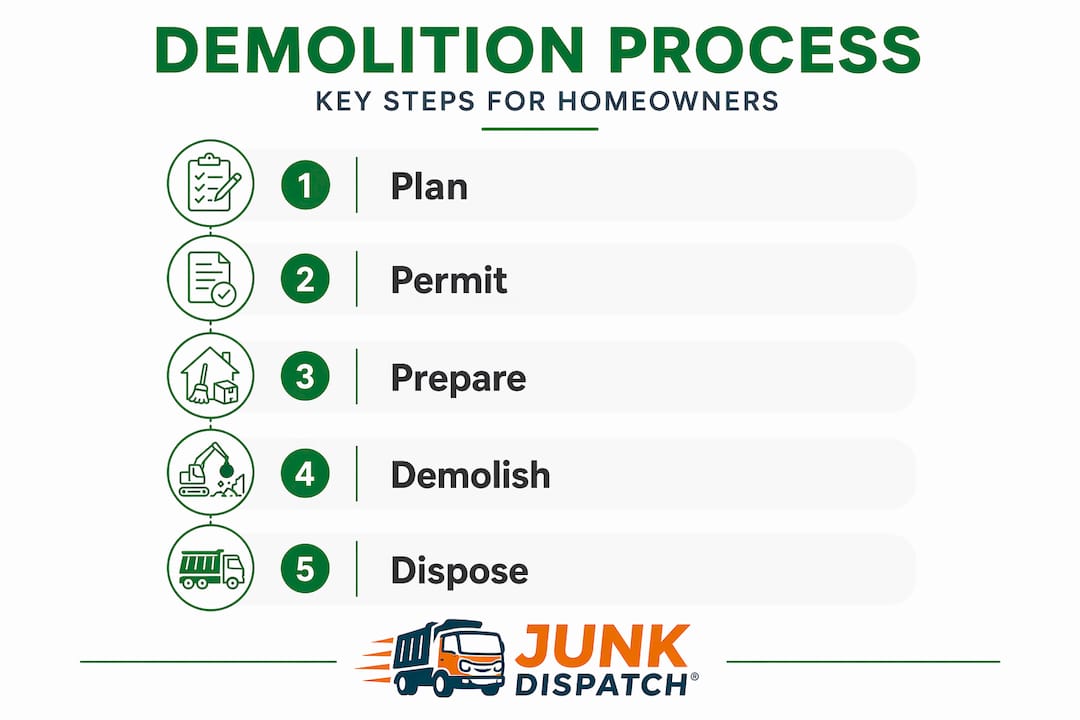
A demolition service covers everything from initial site assessment to final debris haul-away. It is not one person with a sledgehammer. It is a coordinated team of contractors, safety officers, equipment operators, and often environmental specialists working from a documented plan.
What falls under the demolition service definition?
Structural demolition: Full or partial teardown of buildings, walls, foundations, or additions
Interior strip-outs: Removing interior walls, ceilings, flooring, and fixtures before a renovation
Selective demolition: Taking down specific sections while preserving the surrounding structure
Site clearance: Removing old structures to prepare land for new construction
Deconstruction: Systematic disassembly to salvage materials, common in historic properties
Common equipment used includes excavators fitted with hydraulic attachments, skid-steer loaders, and in some cases purpose-built high-reach machines for taller structures. For smaller residential jobs, hand tools and compact equipment handle most of the work.
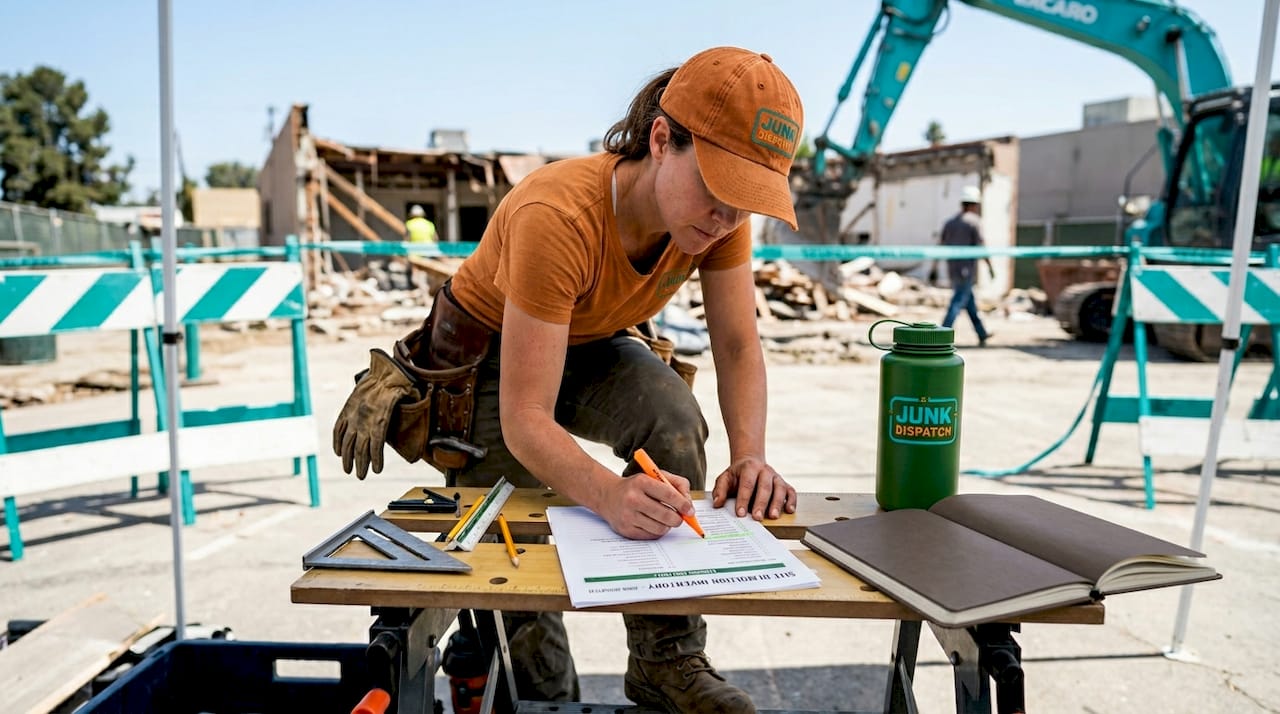
Before a single wall comes down, professional demolition contractors run through a checklist that includes utility disconnections (gas, electric, water), structural engineering reviews, permit applications, and hazardous material surveys. Skipping any of these steps is not just risky. It is often illegal.
Pro Tip: If a contractor quotes you a demolition job without mentioning permits or a hazardous materials survey, that is a major warning sign. Legitimate demolition services in Massachusetts require both before work begins.
Learn more about the scope of demolition services in Massachusetts to understand exactly what your project might require.
Massachusetts demolition regulations: asbestos and safety requirements you must know
Massachusetts does not treat demolition as a simple construction activity. State regulation 310 CMR 7.15 requires removal and disposal of asbestos-containing materials prior to demolition and mandates ongoing controls for asbestos that becomes exposed during the process. This applies to residential and commercial properties alike.
Under Massachusetts law, demolition is specifically defined as any act that destroys a structure or portion of a structure. That definition is broad by design. Even partial teardowns on older buildings can trigger the full regulatory framework.
Key asbestos-related requirements before demolition:
A licensed asbestos inspector must survey the building before any work starts
All friable asbestos (material that crumbles easily and releases fibers) must be abated by a certified contractor
Removed asbestos must be properly packaged, labeled, and transported to a licensed disposal facility
Notifications must be submitted to the Massachusetts Department of Environmental Protection (MassDEP)
Air monitoring may be required during and after abatement
Step-by-step compliance process for Massachusetts projects:
Hire a licensed asbestos inspector for a pre-demolition survey
File notification with MassDEP if asbestos is present
Engage a certified abatement contractor to remove and dispose of asbestos
Obtain a demolition permit from the local building department
Disconnect all utilities with documentation from licensed service providers
Submit safety and demolition plans as required by local ordinance
Proceed with demolition only after all clearances are confirmed
Non-compliance carries real consequences. Fines from MassDEP can reach thousands of dollars per day of violation, and projects halted mid-demolition create costly delays and liability exposure. Proper handling of demolition debris in Massachusetts is just as regulated as the teardown itself.
How demolition methods vary: choosing the right approach for your property
Not every structure gets demolished the same way. Method selection depends on the building’s size, construction type, proximity to neighboring properties, and the presence of hazardous materials. Getting this wrong does not just cause inefficiency. It creates safety hazards for workers and bystanders.
Top-down demolition is often preferred on town-center sites for controlling stability and debris spread, but alternative methods like high-reach equipment may be justified by specific site conditions.
Method | Best suited for | Key advantage | Key limitation |
Top-down manual | Urban sites, tight spaces | Precise control, low debris spread | Slower, more labor intensive |
High-reach excavator | Mid-rise structures | Fast, efficient for height | Requires adequate ground clearance |
Wrecking ball | Open sites, older masonry | Low equipment cost | Poor debris control, not urban-friendly |
Implosion | Large structures with clearance | Fast total collapse | Requires extensive pre-planning and permits |
Selective/hand demo | Interior strip-outs | Protects adjacent structure | Time consuming on large areas |
Factors professional demolition contractors weigh when choosing a method:
Distance to neighboring buildings and utilities
Soil conditions and foundation type
Presence of hazardous materials requiring careful extraction
Local ordinance restrictions on dust, noise, and vibration
Debris volume and on-site staging space
Controlled demolition techniques reduce airborne dust significantly. Wet suppression systems, dust screens, and careful sequencing all play a role. For Massachusetts homeowners near historic districts or high-density neighborhoods, these controls are not optional extras. They are baseline expectations.
Pro Tip: Before finalizing a demolition contractor, ask specifically which method they plan to use and why. A contractor who cannot explain that choice clearly has not planned the project thoroughly enough.
Explore a deeper breakdown of demolition techniques explained for specific project types.
Practical step-by-step guide to hiring and working with demolition services in Massachusetts
Hiring the right demolition service is not just about finding someone with equipment. It is about finding a contractor who knows Massachusetts regulations, can manage hazardous materials properly, and will leave your site clean and compliant.
Asbestos-related steps should be scheduled first to avoid delays and compliance risks during demolition projects. That principle shapes the entire hiring and planning sequence.
Follow this process to hire and manage your demolition project:
Conduct an initial hazard assessment. Before contacting contractors, note the building’s age (pre-1980 construction almost always involves asbestos) and any known hazardous materials.
Request a pre-demolition asbestos survey. Some demolition contractors include this; others require you to hire a separate inspector. Confirm before signing anything.
Gather at least three contractor quotes. Compare scope, method, compliance knowledge, and debris disposal plans, not just price.
Verify licensing and insurance. Massachusetts requires contractors to carry general liability and workers’ compensation insurance. Ask for certificates directly.
Confirm permit responsibility. Clarify whether the contractor or you will pull the demolition permit from the local building department.
Review the demolition plan. A written plan covering sequencing, safety controls, utility disconnections, and debris handling is a baseline expectation.
Arrange post-demolition cleanup. Debris removal is often a separate service. Coordinate it in advance so your site is cleared promptly.
What to look for in a qualified demolition contractor:
Experience with Massachusetts-specific asbestos regulations
Relationships with licensed abatement contractors
Clear communication about timelines and permit status
Transparent pricing with no vague line items
References from recent local projects
Pro Tip: Ask your contractor for their MassDEP notification number once asbestos abatement is filed. If they cannot provide one, the required steps may not have been completed.
Pair your demolition project with a reliable construction debris removal guide so you are prepared for post-project cleanup from day one.
The hidden complexities behind demolition services: why planning and permits matter more than you think
Here is something most clients find out the hard way: the physical tearing down of a structure is almost never the part that causes project delays. It is everything that comes before it.
We have seen Massachusetts homeowners and business owners hire contractors who showed up ready to swing on day one, only to discover mid-project that asbestos abatement had not been filed with MassDEP. Work stops. Fines start. The timeline doubles. Demolition involves many coordinated roles and documented planning, and skipping phases like hazard controls increases the risk of unsafe outcomes and costly delays.
The asbestos issue is the biggest blind spot we see. Massachusetts has some of the most detailed asbestos demolition rules in the country, and they apply to buildings of all sizes. A 1960s ranch house is just as likely to contain regulated materials as a mid-century office building. Assuming otherwise is how projects get shut down.
There is also a persistent misconception that demolition is a commoditized service where the lowest price wins. In reality, the cheapest quote usually skips something. Sometimes it is the hazardous material survey. Sometimes it is proper permit documentation. Sometimes it is debris disposal. Any one of those gaps becomes your legal liability once the project starts.
The demolition expert insights we have gathered from working alongside Massachusetts contractors consistently point to one theme: clients who invest in proper planning spend less overall, finish faster, and avoid the regulatory friction that derails projects. Planning is not overhead. It is the work.
Choose Junk Dispatch for reliable demolition debris removal in Massachusetts
After your demolition wraps up, you are left with a pile of concrete, wood framing, drywall, metal, and mixed debris that needs to go somewhere fast and legally. That is exactly where Junk Dispatch steps in.
We specialize in clearing demolition debris for homeowners and business owners across Massachusetts, with insured crews, transparent pricing, and same-day availability when your timeline demands it. Whether your project is in a dense residential neighborhood or a commercial property, we handle the heavy lifting and responsible disposal so you can move forward. Our service areas include communities across Reading and nearby towns as well as the full Essex County region. Book online, get a free estimate, and let us handle the mess left behind.
Pro Tip: Schedule your debris removal in advance, ideally before demolition starts, so your site is cleared within 24 hours of project completion. Combining demolition and debris removal from coordinated providers keeps your project moving without gaps.
Frequently asked questions
What is a demolition service and how does it differ from just tearing down a building?
A demolition service is a carefully planned engineering process that includes hazard management, permits, and debris removal, not simply knocking down walls. Demolition is the science and engineering of safely dismantling structures, contrasting with deconstruction which preserves valuable elements.
Are there special requirements for demolition in Massachusetts?
Yes. Massachusetts requires removal and disposal of asbestos-containing materials before any demolition begins, along with mandatory notifications to MassDEP and compliance with air-pollution controls under 310 CMR 7.15.
What demolition methods are safest for buildings in urban areas?
Top-down demolition, which removes a structure floor by floor using small equipment, is typically preferred in dense areas. Top-down demolition controls structure stability and limits debris spread, making it the go-to choice for town-center and residential sites.
How can I find a trustworthy demolition service in Massachusetts?
Look for contractors who demonstrate clear knowledge of Massachusetts asbestos regulations, carry proper insurance, provide written demolition plans, and have documented experience on local projects. Professional demolition contractors coordinate permits, hazardous material management, and debris cleanup as part of their standard scope.
Recommended
Comments