Decluttering tips to streamline your Massachusetts facility
- Joe Lusso
- 7 days ago
- 10 min read

TL;DR:
Effective facility decluttering in Massachusetts focuses on high-impact areas like regulatory zones, workstations, and shared spaces to improve safety and efficiency. Centralized digital management and the 5S methodology drive lasting process improvements, while quick wins boost immediate productivity. Continuous, scheduled decluttering practices prevent reaccumulation, supporting ongoing operational excellence.
Running a Massachusetts facility means juggling compliance deadlines, vendor relationships, safety audits, and daily operations all at once. When physical clutter and disorganized processes pile up alongside those responsibilities, productivity stalls, stress climbs, and small problems become expensive ones fast. Decluttering reduces friction, supports focus and task management, and reduces stress for facility teams. This guide walks you through proven, practical strategies to declutter your workspace and operations from the ground up.
Table of Contents
Set your decluttering criteria: Massachusetts facility must-haves
Apply the 5S pillars: Transform storage areas and maintenance rooms
Declutter during transformation: Managing moves and reorganizations
Quick-win tactics: High-impact decluttering for Massachusetts facilities
Our perspective: Decluttering isn’t just removal — it’s strategic transformation
Connect with professional decluttering resources in Massachusetts
Key Takeaways
Point | Details |
Centralize decluttering systems | Digital dashboards and standardized workflows help Massachusetts facility managers prevent missed tasks and reduce confusion. |
Apply 5S for storage | Using the 5S method transforms storerooms, saving time and improving efficiency. |
Treat decluttering as ongoing discipline | Successful facilities maintain decluttering routines instead of one-off cleanups. |
Use quick-win tactics | Clearing desks, categorizing paperwork, and managing cords deliver immediate productivity gains. |
Leverage local experts | Professional junk removal services can accelerate and sustain decluttering efforts for Massachusetts facilities. |
Set your decluttering criteria: Massachusetts facility must-haves
Now that we’ve set the stage, let’s clarify what matters most for Massachusetts facilities when decluttering.
Not every area of your facility deserves equal attention on day one. The most effective decluttering efforts start with a clear set of criteria that connect directly to operational performance, regulatory compliance, and staff wellbeing. Without a defined starting point, decluttering efforts tend to stall or scatter energy across low-priority areas.
Starting with high-impact zones like desks, paperwork, and electrical cords gives you visible results quickly while reducing friction and mental load for your team. These areas tend to accumulate clutter the fastest and cause the most daily disruption.
Here’s what Massachusetts facility managers should prioritize when building their criteria:
Regulatory compliance zones. Hallways, emergency exits, electrical panels, and chemical storage areas must stay clear under Massachusetts safety codes. Clutter here is not just inconvenient, it’s a liability.
High-traffic workstations. Cluttered desks slow down task completion and create mental noise that drains focus. Start here for fast results.
Paperwork and file management areas. Outdated permits, expired vendor contracts, and redundant forms eat up space and make audits harder than they need to be.
Cord and cable management. Loose electrical cords are a safety hazard and signal broader disorganization. Managing them is low-cost with a high impact on both safety ratings and professional appearance.
Break rooms and shared spaces. These areas often become default dumping grounds. Keeping them organized signals operational discipline to staff and visitors alike.
A strong set of criteria also takes into account your team’s workload. Decluttering shouldn’t create disruption that outweighs its benefits. Reviewing office cleanout best practices before you start can help you sequence tasks so operations continue smoothly throughout the process.
Centralize operations: Dashboard-driven decluttering
With criteria in place, let’s tackle operational decluttering, where digital and process organization play a critical role.
Physical clutter is obvious. Operational clutter is harder to see but just as damaging. Missed maintenance tasks, overlapping vendor contacts, duplicate work orders, and outdated procedures all slow your facility down. The fix is centralization.
A centralized place for everything, using a digital dashboard combined with standardized workflows, directly reduces missed tasks, redundant vendor calls, and costly downtime. When your team knows exactly where to log a request, track a repair, or find a vendor contact, confusion disappears and accountability increases.
Operational problem | Without centralization | With centralized dashboard |
Work order tracking | Scattered emails and sticky notes | Single system with status visibility |
Vendor communication | Multiple contacts, repeated calls | Unified vendor directory with history |
Maintenance scheduling | Reactive, often missed | Proactive, automated reminders |
Compliance documentation | Hard to locate under pressure | Stored, searchable, and current |
Cleaning up your digital environment is just as important as clearing a storeroom. Outdated asset lists, duplicate equipment records, and inconsistent naming conventions in your facilities management software create the same friction that physical clutter does. When your data is inaccurate, your decisions will be too.
To streamline your office cleanout process and improve operational clarity, build a habit of verifying digital records at the same time as physical spaces.
Key areas to address in your operational declutter:
Standardize work order formats so any team member can read and act on them without clarification
Consolidate vendor contacts into a single, shared directory updated quarterly
Archive completed compliance documents with a consistent naming system
Remove duplicate entries from your CMMS (computerized maintenance management system) database
Review and retire outdated SOPs (standard operating procedures) that no longer reflect current practice
Pro Tip: Audit your facility’s digital data every quarter. Set a calendar reminder and assign ownership to a specific team member. This prevents the silent accumulation of outdated records that undermines even the best physical decluttering efforts. More ideas for streamlining office junk removal can support your broader operational cleanup goals.
Apply the 5S pillars: Transform storage areas and maintenance rooms
Once processes are centralized, focus on storage and maintenance rooms, where the 5S approach can drive lasting results.
Storage areas and maintenance rooms are where facility clutter concentrates most severely. Tools go missing, parts get ordered twice, and techs waste significant time searching for what they need. The 5S methodology, borrowed from lean manufacturing, gives facility managers a repeatable framework to eliminate this disorder permanently.
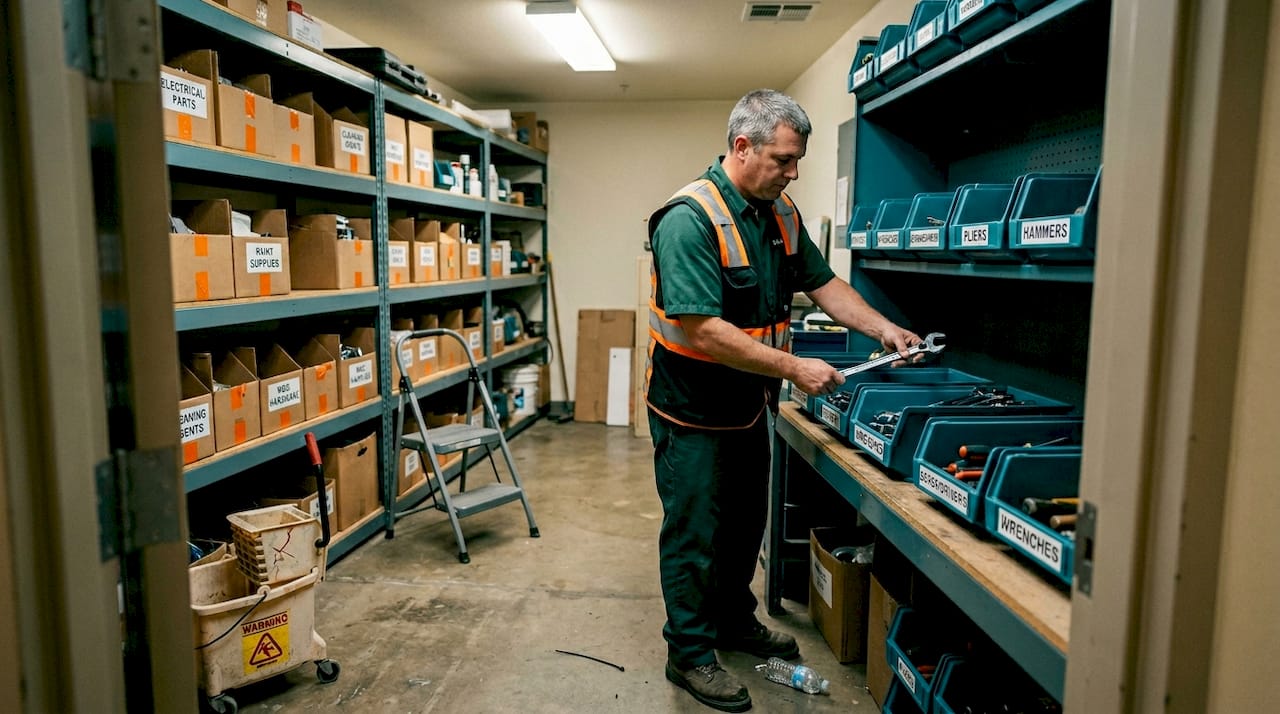
5S implementation reduces parts search time from 5 to 8 minutes down to 1 to 2 minutes per retrieval. Multiply that across a maintenance team handling dozens of requests per week, and the productivity gain becomes substantial.
Here’s how to apply each step in a Massachusetts facility context:
Sort. Go through every item in the storeroom and ask: Is this used regularly? Does it belong here? Is it expired or broken? Remove everything that doesn’t pass the test. Be decisive. Holding onto “just in case” items creates the exact clutter you’re trying to eliminate.
Set in order. Organize what remains by frequency of use and logical grouping. High-use items go at eye level and arm’s reach. Less-used equipment goes on higher shelves. Use visual markers like floor tape and shelf labels so any team member can find what they need, fast.
Shine. Clean the space thoroughly once it’s organized. Maintenance rooms with clean surfaces are easier to keep organized and make it obvious when something is out of place. In Massachusetts facilities with inspections, a clean maintenance area also signals operational professionalism.
Standardize. Document the new layout with a storeroom map. Photograph the organized state and post it inside the room as a reference. Create a short checklist that defines what “organized” looks like for that space so it doesn’t depend on memory.
Sustain. This is where most facilities fall short. Without a sustain plan, 5S gains disappear within weeks. Schedule brief weekly walkthroughs and tie compliance to routine maintenance checklists.
“Applying 5S to facility storerooms isn’t a one-time project. It’s a behavioral shift that makes disorder visible and unacceptable to your entire team.” This mindset shift is what separates facilities that maintain results from those that repeat the same cleanouts every year.
Pro Tip: Label and track every critical inventory item in your CMMS. When team members can see stock levels in real time, they stop over-ordering and under-stocking, both of which create clutter and budget waste.
Use a storage cleanout checklist to guide your Sort and Set in Order phases, and reference office junk removal steps for coordinating removal of surplus items identified during your 5S walkthrough.
5S Step | Time investment | Expected outcome |
Sort | 2 to 4 hours per room | 20 to 40% space recovered |
Set in order | 3 to 5 hours per room | Retrieval time cut by 60 to 75% |
Shine | 1 to 2 hours per room | Inspection-ready environment |
Standardize | 1 to 2 hours total | Consistent team behavior |
Sustain | 15 minutes weekly | Maintained results long-term |
Declutter during transformation: Managing moves and reorganizations
Decluttering doesn’t stop when the facility is on the move. Here’s how to master it during transitions.
Workplace transformations, whether that’s a departmental move, a floor renovation, or a full facility reorganization, create ideal conditions for clutter to multiply. Without deliberate planning, moves scatter files, strand equipment, and leave compliance documents in the wrong location.
The key insight here is that decluttering during transformation should be treated as an operating discipline, not a side task. Plan exactly how people will move their belongings, files, and infrastructure while the facility continues to function.
Here’s what that looks like in practice:
Assign move coordinators. Every department involved in a move should have one point person responsible for decluttering before packing. This prevents the common mistake of moving clutter from one space to another.
Audit before you pack. Before any workstation gets boxed up, require a desk audit. Anything unused for six months gets evaluated for removal or donation.
Protect compliance documents. Massachusetts facilities have specific requirements around record retention for permits, safety inspections, and environmental documentation. These must be tracked and moved with clear chain of custody.
Map new layouts in advance. Before moving furniture and equipment, map where everything will land in the new configuration. Moves without pre-planning create exactly the disorder you’re trying to escape.
Coordinate technology separately. Network cables, server components, and AV equipment need to move in a controlled sequence. Declutter old or unused tech before the move, not after.
Pro Tip: Schedule all transformation tasks during low-traffic hours, early mornings or weekends, to minimize disruption to active operations. Even a single day of unplanned disruption can cost more than the entire decluttering effort saves.
For a structured approach to managing large-scale cleanouts in Massachusetts, a facility cleanout guide covers sequencing, vendor coordination, and compliance considerations specific to this state. If you manage multiple properties, the property manager cleanout guide provides additional frameworks for maintaining consistency across locations.
Quick-win tactics: High-impact decluttering for Massachusetts facilities
Having mastered the big strategies, here’s how to create immediate wins and heightened productivity with small decluttering actions.
Not every improvement requires a multi-week project. Some of the most effective decluttering actions take less than an hour and deliver immediate results that your team can see and feel. These quick wins also build momentum for the larger changes described above.
Quick decluttering actions like desk clearing, paperwork categorization, and cord removal improve focus, task management, and mental health for your facility team. That’s not a soft benefit. It directly affects how quickly and accurately your team responds to requests, manages vendors, and handles compliance tasks.
High-impact quick wins for Massachusetts facility managers:
Clear every desk to a baseline. Only items used daily should be on the desk surface. Everything else gets filed, stored, or removed. This takes about 20 minutes per workstation and immediately reduces cognitive load.
Create a paperwork triage system. Use three bins: action required, file, and shred. Process each bin on a set schedule so paper doesn’t pile up between sessions.
Eliminate cord tangles. Use labeled velcro ties, cable boxes, or cord covers to organize electrical cords under every desk and workstation. In Massachusetts facilities subject to fire code inspections, this also reduces liability.
Post a “belongs elsewhere” box in every shared area. Anything that doesn’t belong in a shared space goes in the box. At the end of each week, the box gets cleared. This single habit prevents shared areas from becoming default storage zones.
Do a five-minute end-of-day reset. Encourage all team members to spend five minutes returning items to their designated locations before leaving. This compounds into a dramatically cleaner facility over weeks.
Massachusetts compliance note: Under Massachusetts General Laws Chapter 149, workplace safety requirements include maintaining clear egress paths and unobstructed access to fire safety equipment. Regular quick-win decluttering routines support these requirements with minimal administrative overhead.
Reviewing resources on office cleanouts and productivity can help you quantify the return on these efforts for leadership reporting. The office cleanout checklist gives you a ready-to-use tool for daily and weekly reset routines.
Our perspective: Decluttering isn’t just removal — it’s strategic transformation
Before we leave you with resources, here’s our hard-won perspective on what decluttering really means for Massachusetts facility managers.
Most facility managers think about decluttering as a physical project. You schedule a cleanout, haul away the excess, feel good for a few weeks, and then watch the clutter return. That cycle repeats because decluttering was treated as an event rather than a discipline.
The facilities that sustain clean, efficient operations in Massachusetts aren’t the ones that do the biggest cleanouts. They’re the ones that build decluttering into how they operate every single day. Operational data cleanliness and standardized processes are just as much a part of decluttering as clearing a storeroom. When your team understands that, the mindset shifts from “cleaning up” to “staying clean.”
Here’s what we see separate the high-performing facilities from the rest: they treat decluttering the way they treat preventive maintenance. It’s scheduled, tracked, and owned. Nobody waits for things to break before acting.
Build a monthly decluttering calendar with assigned owners for each zone, physical and digital. Physical spaces get a monthly walkthrough. Digital records get a quarterly audit. Shared areas get a weekly reset. These aren’t massive time commitments individually, but together they prevent the accumulation that makes reactive cleanouts necessary.
Pro Tip: Resistance to decluttering in your team usually signals that the systems aren’t clear enough. When people don’t know where things belong, they leave them wherever is easiest. Fix the system before blaming the behavior.
For commercial cleanout tips that go beyond the basics, we recommend reviewing how other Massachusetts commercial operators handle recurring cleanout schedules alongside their regular operations.
Connect with professional decluttering resources in Massachusetts
Ready for a smoother, cleaner facility? Connect with trusted Massachusetts experts.
When your decluttering plan uncovers bulky furniture, old equipment, hazardous materials, or years of accumulated debris, you need a removal partner who can move fast without disrupting your operations. That’s where Junk Dispatch comes in.

Junk Dispatch provides same-day and scheduled junk removal across Massachusetts, serving commercial facilities with insured crews, transparent pricing, and eco-conscious disposal practices. Whether you’re clearing a maintenance room after a 5S overhaul or coordinating a full facility move, the team is equipped to handle volume without creating new operational headaches. Facility managers in Reading and across Essex County can book online, get a free estimate, and schedule removal around their operational hours. Clean facilities start with a clear plan and the right partners to execute it.
Frequently asked questions
What are the top areas to declutter first in Massachusetts facilities?
Desks, paperwork storage, and electrical cords are high-impact areas to target first because they deliver fast, visible results and directly improve safety and daily productivity.
How does decluttering improve facility operations?
Centralizing dashboards and structuring work into standardized workflows prevents tasks from falling through the cracks and reduces the operational confusion that costs time and money.
Which decluttering method is most effective for storage rooms?
The 5S methodology (Sort, Set in Order, Shine, Standardize, Sustain) is proven to reduce disorder and cut parts retrieval time dramatically in maintenance and storage environments.
Should digital data be included in facility decluttering?
Yes. Messy facility data drives confusion, duplicate work orders, and costly downtime, making data cleanliness a core part of any serious facility decluttering effort.
How should facility managers handle decluttering during workplace moves?
Coordinate technology, files, and compliance documents with assigned move coordinators and pre-planned layouts to maintain compliance and keep disruption to a minimum during active transitions.
Recommended
Comments