Transparent Junk Removal Pricing: Why It Matters
- Joe Lusso
- Feb 24
- 11 min read


Sorting out junk removal for a busy Massachusetts office building can quickly turn stressful when pricing is unclear and fees keep piling up. Property managers and business owners deserve clear answers before booking any removal service, especially with Massachusetts regulations requiring all fees to be disclosed upfront. This guide breaks down the essentials of transparent junk removal pricing so you never get blindsided by hidden charges and can confidently plan your next cleanout.
Table of Contents
Key Takeaways
Point | Details |
Transparent Pricing | Understand the full cost before service, eliminating hidden fees and surprises for effective budgeting. |
Clear Cost Breakdown | Providers should itemize estimates, ensuring transparency in volume, weight, and labor contributions. |
Accurate Assessments | Request free on-site estimates to avoid under or overestimating debris, which can lead to unexpected charges. |
Regulatory Compliance | Ensure junk removal services adhere to Massachusetts regulations for greater trust and tenant satisfaction. |
What Defines Transparent Junk Removal Pricing
Transparent junk removal pricing means you know exactly what you’ll pay before the work starts. No surprises. No hidden fees buried in fine print. No sudden charges after the crew leaves your Massachusetts property.
This isn’t just about showing a number on a quote. Real transparency involves several core elements that separate trustworthy services from those playing games with pricing.
The Core Elements of Transparent Pricing
Upfront cost disclosure forms the foundation. You should receive a clear, detailed estimate before any equipment arrives at your location. Upfront disclosure of costs with no hidden fees gives you the ability to compare services and make informed decisions for your office cleanout or warehouse project.
A quality estimate includes:
Volume and type of debris being removed
Dumping or recycling fees associated with disposal
Labor costs for the crew and equipment rental
Any additional charges for difficult access or hazardous materials
Final total price with nothing added later
Transparent providers break down each cost category so you understand where your money goes. You’re not paying for a mystery box; you’re paying for specific, identifiable services.
No hidden fees means exactly that. Legitimate junk removal companies won’t add charges for fuel, disposal, or surprise itemizations after the job finishes. Everything mentioned in the estimate should appear on your final invoice at the quoted price.
Property managers handling multiple building cleanouts need this reliability. You can’t budget for projects when prices change without warning.
Transparent pricing builds trust because customers see exactly what they’re paying for before committing to the service.
Honest weight or volume assessments matter too. Some companies overestimate debris amounts to inflate quotes. Transparent services either provide accurate assessments upfront or offer free estimates so you see the real numbers.

For commercial clients, this accuracy prevents budget overruns on office demolition or warehouse clearance projects. You plan your spending knowing the actual cost, not guessing based on inflated estimates.
Clear communication about variables shows professionalism. If certain factors might change the price (like discovering hazardous materials during a commercial cleanout), transparent providers explain this beforehand rather than springing surprises on you.
Many Massachusetts property managers appreciate when junk removal services explain potential variables before starting work. This approach prevents conflicts and maintains professional relationships.
Pro tip: Request an itemized estimate in writing before booking any junk removal service. This written documentation protects you and gives you a clear reference point if questions arise about pricing later.
How Transparent Pricing Models Work
Transparent pricing models break down costs into clear, understandable components. Instead of quoting a lump sum, companies show you exactly what drives the final price. This approach removes guesswork and builds confidence in your decision.
Most legitimate junk removal services use three primary cost drivers: volume, weight, and labor time. Understanding how these combine helps you evaluate quotes and compare providers accurately.
The Three Core Pricing Components
Volume-based pricing focuses on how much space your debris occupies. A truck might hold 10 cubic yards, and pricing reflects how full the truck gets. This works well for office cleanouts with consistent furniture and general waste.
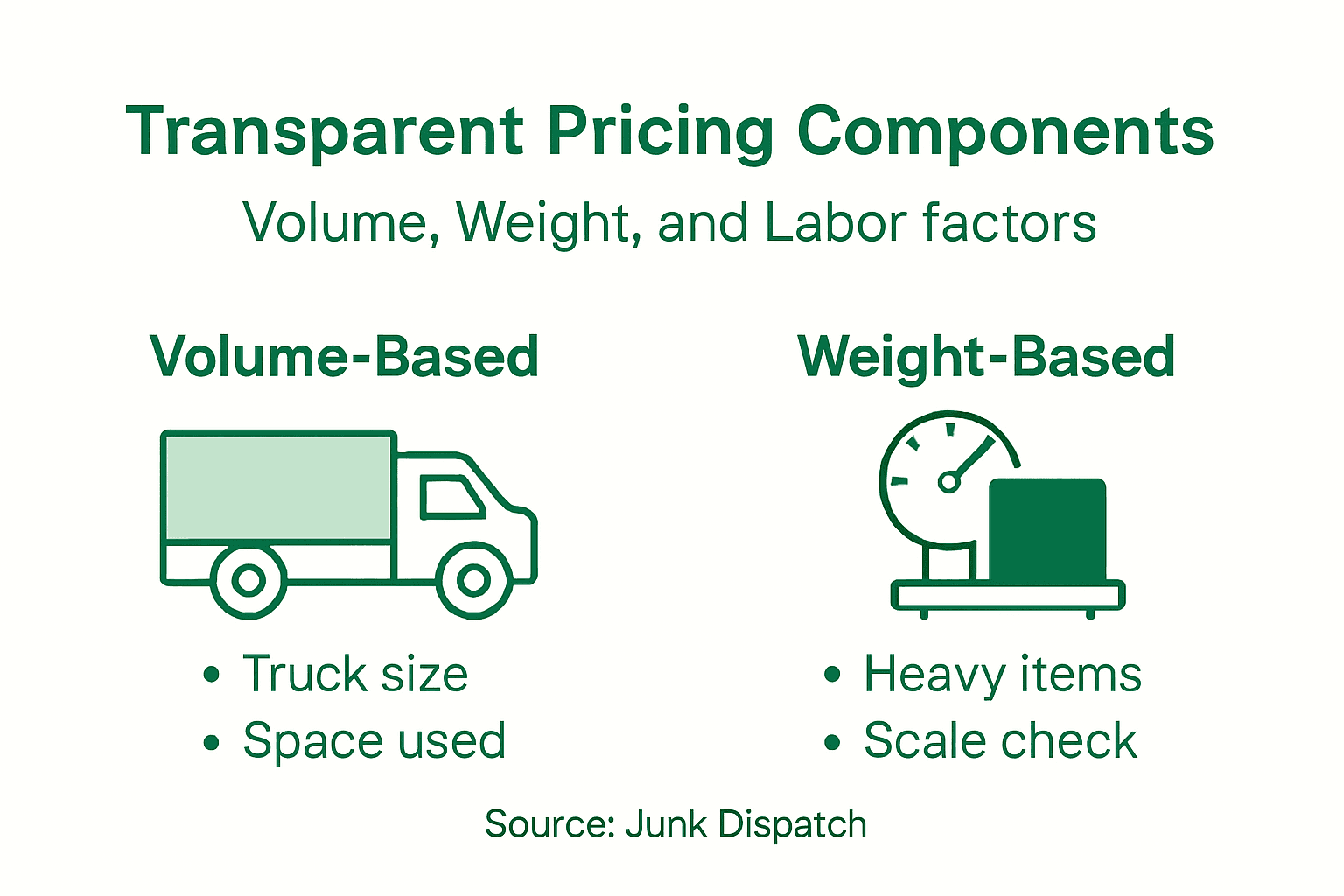
Property managers appreciate volume pricing because it’s predictable. You estimate your debris, and the price follows logically from truck capacity.
Weight-based pricing matters more for heavy materials. Appliances, metal fixtures, and construction debris get weighed, and you pay accordingly. Volume-based, weight-based, and labor factors combine to create your final cost in most transparent models.
This prevents underpricing jobs with heavy but compact loads. A single refrigerator weighs more than ten bags of light office paper.
Labor and time costs represent the crew’s effort. Multiple workers, special equipment, or difficult access situations increase labor charges. Transparent providers specify hourly rates or flat fees for specific labor scenarios.
Commercial clients benefit from clarity here. You know upfront if your warehouse cleanout requires extra crew members or specialized equipment.
Transparent models clearly articulate volume, weight, and labor components upfront so customers understand what drives their final costs.
How These Models Stack Together
Many companies use flat-rate pricing that bundles these factors. A $450 estimate covers the truck space, standard labor, and disposal fees combined. You pay one price, period.
Others employ tiered pricing with brackets:
Quarter-truck load: $150
Half-truck load: $275
Three-quarter truck load: $400
Full truck: $550
Both approaches work, as long as the company explains what’s included. The model matters less than the clarity.
Variable pricing adjusts for specific circumstances. Your estimate starts at $300, but hazardous materials or heavy appliances add $50 each. Transparent companies list these variables beforehand.
This prevents surprise charges when the crew discovers asbestos insulation or three commercial-grade air conditioning units in your warehouse.
Here’s how the main junk removal pricing models differ:
Pricing Model | Calculation Method | Common Use Cases | Potential Challenges |
Flat-Rate | One price covers all costs | Small to medium projects | May hide variables if unclear |
Tiered Pricing | Price by truck load size | Large volume removals | Bracket gaps can confuse |
Variable Pricing | Adjusts for extra factors | Hazardous or bulky items | May increase if not disclosed |
This table helps clarify which pricing model may fit your needs and what to watch for during provider selection.
Pro tip: Ask potential junk removal services to explain which pricing model they use and request a breakdown of how volume, weight, and labor affect your specific quote.
Common Misconceptions About Junk Removal Costs
Property managers and business owners often approach junk removal pricing with assumptions that lead to poor decisions. These misconceptions create confusion, inflate budgets, and sometimes result in paying more than necessary.
Understanding what’s actually true about junk removal costs saves time and money on your next office cleanout or warehouse project.
Misconception #1: The Lowest Quote Always Wins
Many businesses assume the cheapest estimate delivers the best value. This logic sounds reasonable but ignores a critical reality: some providers hide costs.
A $200 quote that suddenly becomes $450 after the crew discovers disposal fees beats a straightforward $350 estimate. Hidden costs obscure true prices, making comparisons difficult and often causing you to pay more than expected.
Property managers handling multiple buildings need consistency. A transparent $350 quote you can budget for reliably outperforms an unpredictable $200 starting price.
Misconception #2: All Debris Costs the Same to Dispose
Some assume appliances, construction waste, and general office clutter incur identical disposal fees. Wrong. Recycling centers charge different rates for different materials.
A warehouse cleanout with refrigerators and metal fixtures costs more to dispose than office furniture and paper waste. Transparent providers break down these material-specific costs upfront.
Misconception #3: Size Estimates Don’t Matter
Property managers sometimes think accurate debris assessment is optional. They’ll “just guess” how much needs removal.
Inaccurate estimates create two problems:
Under-estimating leads to surprise charges mid-project
Over-estimating inflates your budget unnecessarily
Reputable services offer free on-site assessments. Use them.
Misconception #4: Rush Jobs Cost Proportionally More
Many assume same-day junk removal demands premium pricing. Some providers do charge more, but not universally.
Massachusetts junk removal companies often handle same-day projects as standard service. You might pay regular rates for quick turnaround. Always ask before assuming rush fees apply.
Hidden fees and unclear pricing exploit behavioral biases that prevent fair market comparisons and waste business budgets.
Misconception #5: Commercial Projects Always Cost Less Than Residential
Property managers sometimes expect bulk discounts on commercial cleanouts. Volume does sometimes reduce per-unit costs, but commercial projects often involve more complexity.
Warehouse debris with mixed materials, hazardous substances, or restricted access areas can increase labor costs significantly. Size alone doesn’t guarantee savings.
Misconception #6: You Can’t Negotiate Transparent Pricing
Some believe fixed quotes are non-negotiable. Actually, legitimate providers with transparent pricing often accommodate requests.
Asking about partial removal, different disposal methods, or flexible scheduling might reveal pricing adjustments. The openness of transparent companies makes these conversations possible.
Pro tip: Request itemized estimates from at least three providers and compare not just total cost but what’s included—disposal fees, labor rates, and material-specific charges—to identify genuinely transparent pricing.
Key Factors That Affect Final Pricing
Junk removal pricing isn’t arbitrary. Specific factors combine to create your final bill. Understanding these variables helps you anticipate costs and spot when quotes seem unreasonable.
Transparent providers disclose how each factor influences your estimate. This clarity prevents surprises and builds confidence in your decision.
Labor and Time Duration
Crew size matters significantly. A two-person team costs less than a four-person crew, but larger jobs finish faster. Your estimate reflects how many workers the job requires and how long they’ll work.
Office cleanouts lasting two hours with two workers differ dramatically from four-hour warehouse projects needing three crew members.
Travel time affects pricing too. If your property sits far from the junk removal company’s base, that distance gets factored into labor costs. A 45-minute drive each way adds overhead.
Massachusetts property managers benefit when companies operate locally. Reduced travel distances lower your final bill.
Accessibility and Location Challenges
Difficult access increases costs directly. Hauling debris from a fourth-floor office down narrow stairwells takes longer than ground-level removal. Rooftop storage areas, cramped warehouse corners, or multiple loading zones demand extra labor time.
Transparent estimates specify these accessibility factors upfront.
Parking and site conditions matter. If the crew can’t park near your building, they’ll walk debris farther. Muddy ground, snow, or steep terrain slows work and increases labor costs.
Disposal and Recycling Fees
Labor duration, distance, accessibility challenges, and disposal fees for specific items all influence your final price. Different materials incur different disposal or recycling costs.
Breakdown of typical disposal variables:
Appliances with refrigerants: premium fees for proper handling
Metal and scrap materials: sometimes generates recycling credits
Construction debris: varies by material type and local landfill rates
Electronics: specialized recycling facilities charge processing fees
General office waste: lowest disposal cost category
Regional Economic Factors
Local market conditions affect pricing. Massachusetts urban areas often cost more than rural regions. Landfill proximity, local labor rates, and regional tipping fees vary.
A Boston office cleanout typically costs more than an equivalent Berkshire County project.
Environmental policies impact costs. Massachusetts has strict waste regulations. Some disposal methods cost more here than other states due to environmental compliance requirements.
Transparent companies factor these regional realities into estimates.
Here’s a quick summary of factors impacting your final bill:
Factor | Description | Impact on Cost |
Crew Size | Number of workers on-site | Larger crews cost more |
Labor Duration | Time required to complete job | Longer jobs increase cost |
Accessibility | Ease of removing debris | Difficult access adds charges |
Disposal Fees | Charges for specific materials | Higher for appliances or hazards |
Regional Economics | Local market and regulations | Urban areas usually pricier |
Understanding these variables enables more accurate budgeting for property managers.
Multiple factors combine to create final pricing: labor time, distance, accessibility, material-specific disposal fees, and regional economic conditions all affect your bill.
Pro tip: When requesting estimates, provide detailed information about crew access, property location, and specific debris types—the more details you share, the more accurate your pricing becomes.
Benefits for Massachusetts Property Managers
Transparent junk removal pricing delivers specific advantages to property managers handling multiple buildings and budgets. Massachusetts regulations actively support this transparency, creating tangible benefits for your operations.
Understanding these advantages helps you leverage transparent pricing to improve your bottom line and tenant relationships.
Accurate Budget Planning
Predictable costs eliminate surprises. When you know exactly what junk removal will cost before the crew arrives, budgeting becomes straightforward. No mid-project price increases. No hidden disposal fees that blow through your contingency fund.
Property managers handling ten buildings appreciate this consistency. You can allocate funds precisely across multiple properties without setting aside excessive padding for unknown costs.
Multi-property transparency scales efficiently. Managing ten office buildings or commercial complexes requires coordination across locations. Transparent pricing from one junk removal provider means you understand costs for each site upfront.
This consistency also simplifies comparing providers across your entire portfolio.
Regulatory Compliance and Tenant Trust
Massachusetts has established clear rules about disclosure. Junk fee regulations require upfront disclosure of all fees, creating price transparency that protects both you and your tenants from unexpected charges.
When tenants see transparent pricing, they trust the process. This reduces disputes and strengthens your professional reputation.
Compliance protects your business. Using transparent junk removal services keeps you aligned with Massachusetts standards. You’re not caught in regulatory conflicts if tenants question hidden fees or deceptive practices.
Comparison Shopping Made Simple
Transparent pricing helps you avoid surprise fees and enables comparison shopping across multiple service providers. When all companies disclose pricing the same way, you evaluate them fairly.
Benefits of transparent comparison:
Itemized costs show exactly what you’re paying for
Labor rates, disposal fees, and vehicle charges align for easier analysis
Material-specific pricing becomes clear across quotes
Regional variations show legitimate cost differences
Service quality differentiates providers beyond price alone
Improved Tenant Satisfaction
Tenants appreciate honesty. When your building uses transparent junk removal services for common area cleanouts, tenants notice the professionalism. They see straightforward pricing, not games or hidden charges.
This experience reflects positively on your property management.
Dispute reduction saves time. Hidden fees create conflicts. Transparent pricing eliminates disagreements about surprise charges. You spend less time managing complaints and more time on actual property management.
Transparent junk removal pricing in Massachusetts aligns with state regulations while improving your budgeting accuracy, tenant relationships, and operational efficiency.
Operational Efficiency
Time savings during vendor selection. You spend less time negotiating, questioning unexpected charges, or resolving billing disputes. Transparent providers handle everything clearly from the start.
Your administrative staff focuses on other priorities.
Pro tip: Request written quotes from transparent junk removal providers that itemize labor costs, disposal fees by material type, and any accessibility-related charges—keep these organized by property to track spending patterns and identify savings opportunities across your portfolio.
Experience Truly Transparent Junk Removal with Junk Dispatch
Understanding transparent junk removal pricing is essential for Massachusetts property managers and business owners who want to avoid hidden fees and unpredictable charges. If you value upfront cost disclosure and want clear breakdowns of volume, weight, and labor fees for your office or warehouse cleanouts, Junk Dispatch offers the solution you need. We provide free estimates, guaranteed transparent pricing, and eco-friendly disposal that aligns with local regulations.
Don’t let confusing quotes or surprise fees disrupt your project budget or tenant relationships. Choose Junk Dispatch for quick, reliable, and honest junk removal services tailored for both residential and commercial clients. Visit Junk Dispatch now to get your itemized estimate and experience hassle-free junk removal with complete pricing clarity.
Frequently Asked Questions
What is transparent junk removal pricing?
Transparent junk removal pricing means you receive a clear and detailed estimate before any work begins, with no hidden fees or unexpected charges.
Why is upfront cost disclosure important?
Upfront cost disclosure allows you to compare services accurately, ensuring you understand what each component of the pricing entails without any surprises in the final bill.
How do volume-based and weight-based pricing work for junk removal?
Volume-based pricing depends on the amount of space your debris occupies in the truck, while weight-based pricing charges based on the actual weight of the items being removed. Each method affects the final pricing differently.
What factors can influence the final cost of junk removal?
Factors affecting final costs include crew size and labor duration, disposal and recycling fees for specific materials, accessibility challenges, and regional economic conditions. Understanding these can help you anticipate expenses.
Recommended
Comments